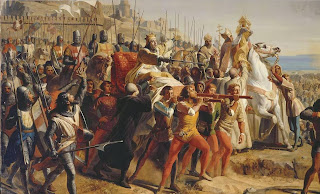
Titus - the destroyer of Jerusalem
Born on December 30, 39 AD, Titus Vespasianus Augustus was the son of Emperor Vespasian and a Roman Emperor himself between the years 79 to 81.
His journey to Judea began In 67 AD, when Titus accompanied his father, Vespasian, after being appointed to recapture the country from the hands of the rebelling Jews. A year earlier, the Judean province had declared independence when Jewish warriors succeeded in driving the Roman legions out of the country.
Both father and son waged a successful campaign which regained Roman control over most parts of the province. This campaign came to a brief halt with the death of the Emperor Nero in 68, and the return of Vespasian back to Rome as an Emperor, by the end of the Year of the Four Emperors (69 AD).
Titus was now the head of the Roman army in Judea, leading four Roman legions with auxiliary forces from the Levant to Jerusalem which had not yet surrendered. His army besieged the city for three and a half months. Titus finally managed to breach the city walls in the Jewish month of AV (circa September) 70 AD and to destroy the lower city and its Temple. A month later, Titus captured and demolished the upper city of Jerusalem and with that came to its end the main Jewish resistance which lasted for four years.
 |
| Titus Flavius Caesar Vespasianus Augustus |
His journey to Judea began In 67 AD, when Titus accompanied his father, Vespasian, after being appointed to recapture the country from the hands of the rebelling Jews. A year earlier, the Judean province had declared independence when Jewish warriors succeeded in driving the Roman legions out of the country.
Both father and son waged a successful campaign which regained Roman control over most parts of the province. This campaign came to a brief halt with the death of the Emperor Nero in 68, and the return of Vespasian back to Rome as an Emperor, by the end of the Year of the Four Emperors (69 AD).
Titus was now the head of the Roman army in Judea, leading four Roman legions with auxiliary forces from the Levant to Jerusalem which had not yet surrendered. His army besieged the city for three and a half months. Titus finally managed to breach the city walls in the Jewish month of AV (circa September) 70 AD and to destroy the lower city and its Temple. A month later, Titus captured and demolished the upper city of Jerusalem and with that came to its end the main Jewish resistance which lasted for four years.
The historian Josephus notes that Titus ordered not to destroy the temple, but in the heat of the battle a Roman soldier threw a torch into the "golden window" of the Temple. Josephus also states that Titus tried to extinguish the fire that gripped the temple after being torched, but his voice did not sound due to the cries of battle and turmoil prevailed.
Other sources claim that it was indeed Titus who ordered deliberately the destruction of the Temple. It is likely that the reports by Josephus are designed to cover up the responsibility of the Roman general because of the fact of him being a protege of Titus' Flavian family.
Titus stayed for a while more in Judea after completing the suppression of the Jewish revolt and held games in Caesarea in which 2,500 prisoners found their death.
He returned to Rome in 71 Ad.
After his father's death in 79, Titus succeeded him and two years later, at the age of 42, he died of illness in the hometown of his father.
The Arch of Titus in Rome commemorates his victory in Judea to this day.
Available in our Etsy shop: